Why ZK proofs matter for AI models
Zero-knowledge proofs (ZKPs) are a cryptographic method that allows one party to prove they know a value or have performed a computation without revealing the underlying data. This technology solves a fundamental conflict in modern AI: the need for transparency versus the need for privacy. As AI models grow more powerful, they process sensitive user data and proprietary training sets. ZK proofs allow applications to verify that an AI model was trained on clean, unbiased data or that a specific inference was generated correctly, all without exposing the raw inputs or the model's weights.
In 2026, this capability is critical for blockchain trust. Traditional AI systems are often "black boxes," making it difficult to audit how decisions are made. By integrating ZK proofs, developers can create verifiable AI systems where the output is cryptographically guaranteed to be correct based on specific, auditable constraints. This shift moves AI from a trust-based relationship to a mathematically verifiable one, ensuring that the data powering these models remains secure while still being subject to rigorous validation.
Top ZK model proof tools for 2026
The landscape for ZK model proofs is shifting from theoretical frameworks to production-ready tooling. In 2026, the focus is on tools that can handle the computational heaviness of AI verification while maintaining strict privacy guarantees. These platforms allow developers to prove that an AI model ran correctly without exposing the underlying weights or sensitive training data.
The following tools represent the current standard for verifying AI integrity. They range from full-stack proving systems to specialized libraries designed for high-throughput inference validation.
Polygon zkEVM
Polygon zkEVM has emerged as a leading infrastructure layer for integrating zero-knowledge proofs into AI workflows. While originally designed for Ethereum scaling, its robust support for EVM-equivalent circuits makes it a preferred choice for deploying AI verification contracts. It allows developers to generate proofs for model inferences on-chain with minimal latency.
The platform’s maturity means it offers extensive documentation and community support, which is critical when debugging complex circuit constraints. For teams building decentralized AI applications, Polygon provides a familiar development environment that bridges the gap between traditional AI engineering and ZK cryptography.
Starknet
Starknet utilizes STARK-based proofs to offer a highly scalable environment for ZK model verification. Its key advantage lies in its ability to handle complex computational circuits without the need for a trusted setup, enhancing the trustlessness of the verification process. This makes it particularly suitable for large-scale AI models that require rigorous mathematical proof of their output integrity.
Developers leveraging Starknet benefit from its high throughput, which is essential when processing the large datasets typical in machine learning tasks. The ecosystem supports a growing number of AI-focused projects that use Starknet to validate model behavior without revealing proprietary algorithms.
Aztec
Aztec focuses on privacy-preserving smart contracts, making it a strong candidate for AI applications where data confidentiality is paramount. Its framework allows for the creation of confidential AI models that can process sensitive user data while only publishing the proof of correct execution. This is particularly valuable in healthcare and finance, where AI decisions must be auditable but private.
The tool’s emphasis on confidential computing ensures that the inputs and outputs of AI models remain hidden from the public ledger, while still providing cryptographic proof that the model operated as intended. This balance of transparency and privacy is a defining feature of modern ZK AI solutions.
Circom
Circom is a low-level domain-specific language for writing arithmetic circuits, serving as the foundational building block for many ZK applications. For AI model proofs, Circom allows engineers to define the exact mathematical operations performed by the neural network, ensuring that the proof accurately reflects the model’s logic.
While it requires a deeper understanding of circuit design, Circom offers unparalleled flexibility for custom AI verification needs. It is often used in conjunction with higher-level frameworks to create bespoke proofs for unique AI architectures that generic tools cannot support.
Halo2
Halo2 is a modular proving system developed by Zcash, designed for efficiency and ease of integration. It supports recursive proofs, which are crucial for scaling AI verification by allowing multiple smaller proofs to be combined into a single verification step. This reduces the computational burden on the verifier, making real-time AI validation more feasible.
The system’s modularity allows developers to optimize specific parts of the proving process, such as gate selection and witness generation. This adaptability makes Halo2 a preferred choice for projects that need to fine-tune their ZK proofs for specific AI workloads.
Comparison of ZK Model Proof Tools
The table below compares the key features of the top ZK model proof tools, focusing on throughput, privacy guarantees, and AI-specific support.
| Tool | Proof Type | Throughput | AI Support |
|---|---|---|---|
| Polygon zkEVM | PLONK | High | Strong (EVM Integration) |
| Starknet | STARK | Very High | Strong (Complex Circuits) |
| Aztec | PLONK | Medium | High (Confidentiality) |
| Circom | PLONK | Variable | Custom (Low-Level) |
| Halo2 | Halo 2 | High | Strong (Recursive Proofs) |
How ZK proofs verify AI training data
Verifying that an AI model was trained on specific, authorized datasets requires proving the computation without exposing the underlying data. Zero-knowledge proofs (ZKPs) allow a model provider to demonstrate that their training process adhered to strict constraints—such as using only public domain data or licensed corpora—while keeping the actual training examples hidden.
This process transforms opaque "black box" training into a verifiable audit trail. Instead of trusting the provider's word, stakeholders can cryptographically verify that the model's weights resulted from a valid execution of the training algorithm on the claimed dataset.
1. Data Hashing and Constraint Definition
The first step involves creating a cryptographic fingerprint of the training dataset. Each data point is hashed, and these hashes are aggregated into a Merkle tree. This structure allows the system to verify that specific data points were included in the training set without revealing the content of those points. Developers then define algebraic constraints that represent the training logic, ensuring the proof circuit matches the intended computational steps.
2. Circuit Generation
Next, the high-level intent of the training process is translated into a ZK circuit. This circuit acts as a digital program that enforces the rules of the training algorithm. It checks that the model's weights were updated correctly based on the hashed data inputs. This step is critical because it defines the boundaries of what is being proved; any deviation from the authorized data or algorithm will cause the circuit to fail.
3. Proof Generation
With the circuit defined, the provider runs the actual training computation or a simulated version of it to generate the proof. This involves complex mathematical operations that demonstrate the correctness of the computation. The resulting proof is a compact cryptographic artifact that attests to the validity of the training process. Modern tools leverage large language models to assist in generating the code for these circuits, reducing the manual engineering burden.
4. On-Chain Verification
Finally, the proof is submitted to a blockchain or a verification service. Verifiers check the proof against the circuit's public parameters. If the proof is valid, it confirms that the model was trained on the authorized dataset without revealing the data itself. This creates a transparent, immutable record of compliance that can be audited by regulators, investors, or users.
Translate the authorized dataset and training algorithm into algebraic constraints that the ZK circuit must satisfy.
Build the ZK circuit code, often using AI-assisted tools, to enforce the defined constraints during computation.
Run the training simulation or actual computation to generate the cryptographic proof of correct execution.
Submit the proof to a blockchain or verifier to confirm the model's training data compliance without revealing the data.


As an Amazon Associate, we may earn from qualifying purchases.
ZK Proofs for Blockchain Scalability
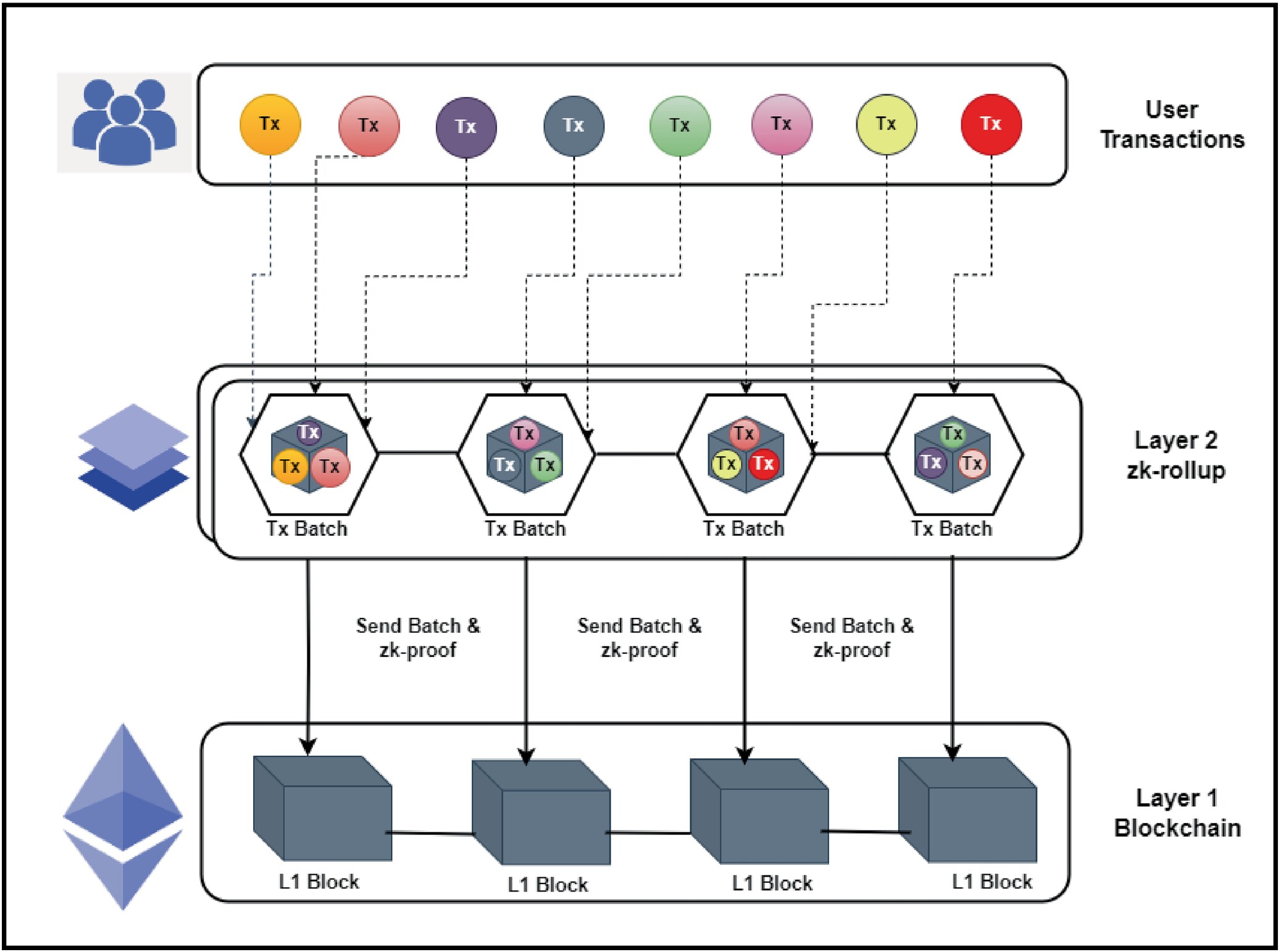
Zero-knowledge proofs (ZKPs) have shifted from a privacy-focused niche to a core infrastructure layer for blockchain scalability. By allowing a network to verify the validity of a transaction without re-executing the underlying computation, ZKPs solve the "verification bottleneck" that slows down traditional chains. For AI-generated transactions, this is critical: it enables off-chain heavy lifting—such as validating complex model outputs or processing large data sets—while keeping the on-chain footprint minimal and secure.
This architecture supports what is known as a ZK-rollup. The rollup bundles thousands of individual transactions off-chain, generates a single ZK proof attesting to their correctness, and submits that proof to the main blockchain. This approach drastically reduces gas fees and increases throughput, making it feasible to handle the high-frequency, data-intensive transactions typical of AI agents and automated smart contracts.
Major protocols are already integrating this technology. Ethereum’s roadmap includes plans to use ZK proofs for faster block validation, offering a testing ground for zk-based options alongside existing methods. Meanwhile, projects like StarkNet and zkSync are building dedicated rollup layers that prioritize speed and cost-efficiency. These tools provide the necessary infrastructure to scale AI-driven applications without compromising the security guarantees of the underlying blockchain.
Frequently asked questions about ZK proofs
How do ZK proofs protect AI model weights?
ZK proofs do not directly protect the weights themselves in storage, but they allow a model to prove it used specific weights to generate an output without revealing those weights. This ensures that proprietary algorithms remain confidential while still allowing external parties to verify the correctness of the inference.
What is the computational cost of ZK AI verification?
Generating ZK proofs for large AI models is computationally expensive, often requiring significant CPU/GPU resources. However, verification on-chain is cheap. The trade-off is high upfront generation cost for low-cost, trustless verification, which is viable for high-value or high-frequency AI transactions.
Can ZK proofs detect AI bias?
ZK proofs can verify that a model was trained on a specific dataset, but they cannot inherently detect bias within that dataset. They prove how the model was trained, not the ethical quality of the training data. Bias detection requires separate, non-cryptographic auditing processes.
No comments yet. Be the first to share your thoughts!