Define the verification scope
Before writing circuit code, determine the specific aspect of the model requiring cryptographic assurance. The architecture of your Zero-Knowledge (ZK) circuit depends entirely on this choice. Attempting to prove both training data provenance and inference correctness in a single circuit is currently prohibitively expensive for real-time verification. Isolate one proof type to manage computational overhead and circuit complexity.
Proving Inference Correctness
Inference verification ensures that a specific output was generated by the claimed model weights given a specific input. This is the most common immediate use case for ZK model proofs. You are proving that the neural network operations (matrix multiplications, activations) were executed correctly without revealing the model parameters or the input data.
This scope typically involves generating a proof that the circuit output matches the model's deterministic forward pass. It is suitable for scenarios where a user wants to verify that a cloud provider ran a specific model on their data without leaking proprietary model weights. The circuit must accurately represent the arithmetic logic of the neural network layers.
Proving Training Data Provenance
Training data provenance focuses on the origin and integrity of the dataset used to train the model. This scope proves that the model was trained on a specific dataset or a verifiable subset thereof, without exposing the raw data itself. This is critical for compliance, copyright verification, and ensuring models were not trained on restricted or poisoned data.
Implementing this scope requires a different circuit design that handles data ingestion and aggregation proofs rather than forward-pass arithmetic. You are proving the relationship between the training data and the resulting model weights. This is computationally intensive and often requires batched proofs or recursive verification strategies to remain feasible.
Choosing the wrong scope early in development leads to bloated circuits and unsustainable proving times. Start with inference verification if your goal is trustless execution; choose data provenance if your goal is auditability and compliance.
Select the ZK circuit framework
Implementing ZK Model Proofs works best as a clear sequence: define the constraint, compare the realistic options, test the tradeoff, and choose the path with the fewest hidden costs. That order keeps the advice usable instead of decorative.
| Factor | What to check | Why it matters |
|---|---|---|
| Fit | Match the option to the primary use case. | A good deal still fails if it does not fit the job. |
| Condition | Verify age, wear, and service history. | Hidden condition issues erase upfront savings. |
| Cost | Compare purchase price with likely upkeep. | The cheapest option is not always the lowest-cost option. |
Encode model weights as limits to account for
Translating a trained neural network into a zero-knowledge proof requires converting continuous floating-point operations into discrete algebraic constraints. This process, often called constraint generation, maps the model’s arithmetic logic to a finite field that the ZK prover can verify. Instead of executing the model, you define a system of equations where the solution corresponds to a valid inference.
1. Quantize weights and activations
Neural networks typically use 32-bit or 16-bit floating-point numbers, which are incompatible with most ZK circuits that operate over prime fields. You must first quantize the weights and activations to a smaller integer range, such as 8-bit integers or fixed-point decimals. This step reduces the computational complexity significantly. Ensure that the quantization scheme preserves enough precision to maintain the model’s accuracy within acceptable error bounds.
2. Map to a finite field
Select a prime field $\mathbbF_p$ large enough to hold your quantized values without overflow. Common choices include BN254 or BLS12-381 scalar fields. Every weight and activation value must be represented as an element in this field. This mapping ensures that all subsequent arithmetic operations (addition, multiplication) remain closed within the field, which is a strict requirement for algebraic constraint systems.
3. Generate arithmetic circuits
Break down the neural network into its primitive operations: matrix multiplications, additions, and non-linear activations like ReLU or sigmoid. Each operation becomes a gate in an arithmetic circuit. For example, a matrix multiplication $y = Wx + b$ is decomposed into individual dot products. Each dot product is represented by a series of multiplication gates and addition gates. This decomposition creates the backbone of your R1CS (Rank-1 Constraint System).
4. Compile to R1CS
The final step is compiling these gates into a structured format like R1CS or QAP (Quadratic Arithmetic Programs). In R1CS, the circuit is represented as a set of quadratic equations $A \cdot s \times B \cdot s = C \cdot s$, where $s$ is the witness vector containing inputs, weights, and intermediate states. Tools like Circom or Gnark automate this compilation, taking your high-level circuit definition and outputting the constraint matrices needed for proof generation.
// Example: Simple multiplication gate in Circom
pragma circom 2.0.0;

template Multiplier() {
   signal input a;
   signal input b;
   signal output c;

   c <== a * b;
}

component main = Multiplier();
This constraint system allows the prover to demonstrate that they possess a valid set of weights and inputs that produce the correct output, without revealing the underlying data. The complexity of the proof scales with the number of gates in the circuit, making efficient quantization and circuit design critical for performance.
Optimize for real-time verification
The primary bottleneck in ZK model proofs is the prover's time-to-solution. As model complexity grows, the constraint system expands, making single-step verification computationally prohibitive for on-chain deployment. To address this, you must shift from monolithic proof generation to recursive proof architectures.
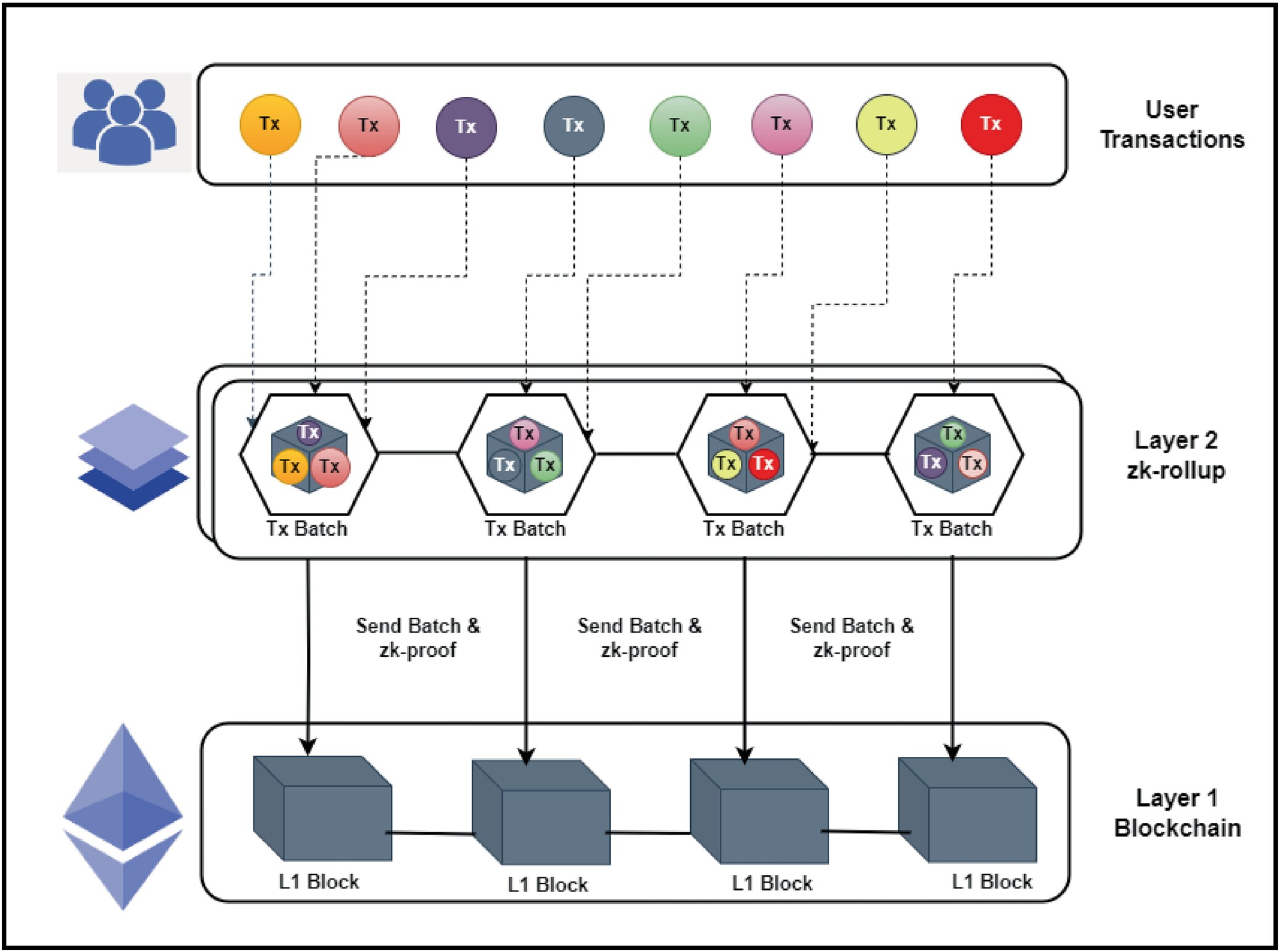
Recursive proofs allow you to aggregate multiple smaller proofs into a single, compact verification. This reduces the on-chain verification cost significantly. For example, you can generate individual proofs for each layer of a neural network inference and then combine them. This approach often reduces on-chain gas costs by up to 90% compared to verifying a single, massive proof.
To implement this, structure your circuit to support composition. Instead of proving the entire model in one go, break the computation into discrete steps. Use a recursive aggregator circuit that verifies the consistency of these steps. This not only lowers verification latency but also enables parallel prover strategies, where different workers handle different segments of the constraint system simultaneously.
When designing for recursion, ensure your constraint gates are compatible with the aggregation scheme. Mismatched gate sets can introduce overhead that negates the benefits of recursion. Focus on minimizing the number of constraints per layer while maintaining the integrity of the mathematical proof. This balance is critical for achieving the real-time performance required for practical AI verification.
Validate the proof on-chain
After generating the ZK model proof, the final step is deploying the verifier contract and submitting the proof for on-chain validation. This process ensures that the AI model’s output is mathematically sound without revealing the underlying data or weights. The verifier contract acts as the gatekeeper, checking the proof’s validity against the public parameters.
Deploy the Verifier Contract
First, deploy the generated verifier contract to your target blockchain. This contract contains the verification keys and the logic to check the proof. Ensure the contract is compatible with your chain’s EVM or specific ZK-enabled environment. You will need the compiled contract bytecode and ABI for this step.
Prepare the Proof Data
The proof generated by your ZK circuit must be formatted correctly for the verifier. Typically, this involves converting the proof elements (such as group elements in elliptic curve cryptography) into a format the smart contract can ingest. You may need to serialize the proof into a byte array or specific tuple structure depending on the verifier’s interface.
Submit the Proof
Call the verify function on your deployed verifier contract, passing the serialized proof and any public inputs. This transaction will trigger the on-chain verification logic. If the proof is valid, the transaction will succeed, and the result can be recorded. If invalid, the transaction will revert, preventing fraudulent results from being accepted.
Verify the Result
After the transaction completes, check the event logs or the contract’s state to confirm the proof was accepted. You can also use block explorers to view the transaction details and ensure the gas costs were reasonable. This on-chain confirmation is the final trustless validation that the AI model’s output is authentic.
Common pitfalls in ZK AI proofs
Zero-knowledge programming requires translating high-level intent into strict algebraic constraints, a process that leaves little room for ambiguity. When building ZK AI proofs, developers frequently encounter structural errors that cause verification to fail silently or generate prohibitive proof times. The following errors are the most common causes of failure in production environments.
Incorrect Field Mapping
The most frequent cause of verification failure is a mismatch between the data representation in the constraint system and the underlying finite field. If a model expects inputs in F_p but receives normalized floats or improperly encoded strings, the constraint solver will reject the proof. Always verify that tensor shapes and data types align exactly with the circuit’s expected domain before compilation.
Memory Leaks in Constraint Generation
Unlike standard application code, constraint generation is stateful. If intermediate variables or witness data are not explicitly cleared or garbage-collected between proof rounds, memory usage grows linearly with the number of proofs. This "leak" can crash the prover node during batch processing. Implement strict scope management for all temporary variables within the constraint builder.
Over-Constraining the Circuit
Developers often add redundant constraints to "ensure" correctness, which significantly increases the circuit size and proof generation time without adding security. Only include constraints that are mathematically necessary to bind the witness to the public input. Use automated constraint minimization tools to identify and remove redundant logic before deployment.
Implementation Checklist
Before deploying your ZK model proof, run through this sequence to ensure correctness and performance. Translating high-level intent into algebraic constraints requires precision at every stage.
- Select a Framework: Choose a tool like Circom, Halo2, or RISC Zero that matches your circuit’s complexity and target platform.
- Generate Constraints: Define the arithmetic gates and boolean logic that encode your model’s forward pass. Keep the witness generation separate from the circuit logic.
- Optimize the Circuit: Minimize the number of constraints to reduce proving time. Look for repeated sub-expressions and factor them out.
- Test Locally: Run unit tests against known inputs and outputs. Verify that the witness generation matches the expected model inference.
- Deploy the Verifier: Integrate the verification key into your smart contract or client application. Ensure the public inputs are correctly formatted.
- Audit the Code: Review the constraint generation for side-channel leaks or logical errors. Automated audits are essential for production-grade proofs.
A missed constraint can invalidate the entire proof. Treat the circuit as a strict mathematical function, not just code.
Frequently asked: what to check next
Work through 2026 Guide: Implementing ZK Model Proofs for Real-Time AI Verification
No comments yet. Be the first to share your thoughts!