What is zero-knowledge machine learning
Zero-knowledge machine learning (ZKML) is a method that allows a model to prove its computations were performed correctly without revealing the underlying data or the model’s internal weights. In 2026, this capability has become essential for AI transparency and privacy, enabling organizations to verify AI decisions without exposing sensitive proprietary information or user data.
Unlike standard encryption, which protects data at rest or in transit, ZKML focuses on the integrity of the computation itself. When a machine learning model generates a prediction, ZKML generates a cryptographic proof that the prediction was derived from the correct algorithm and inputs. This proof can be verified by anyone without needing to see the model’s architecture or the training dataset.
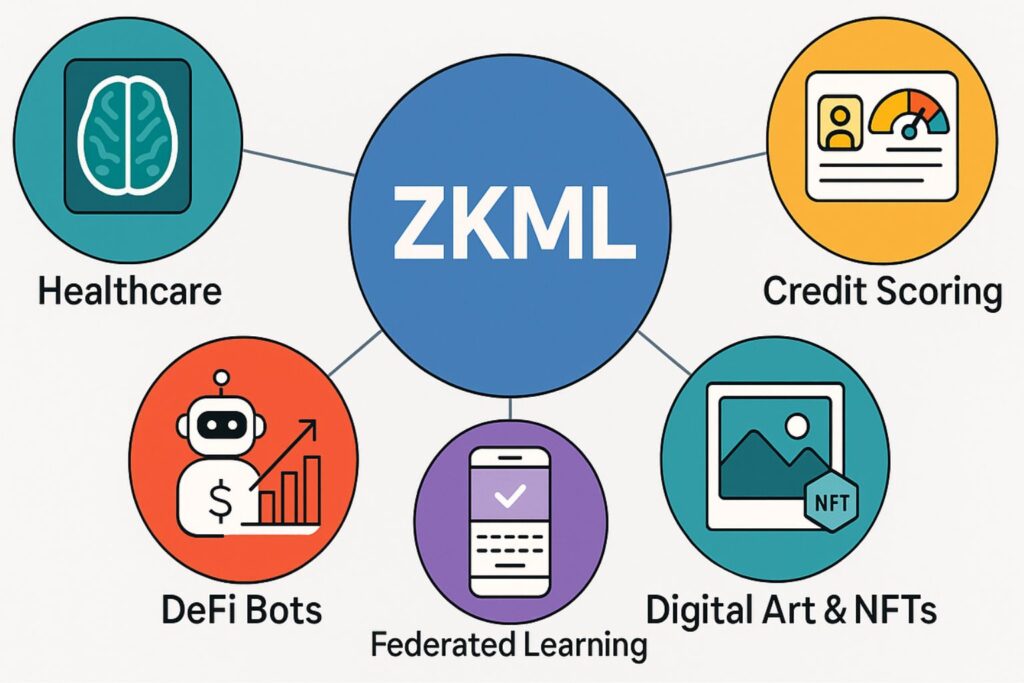
This approach matters because it resolves the tension between accuracy and privacy. Traditional methods often require sharing data with third-party AI providers, creating security risks. ZKML allows users to verify that an AI system is behaving as expected while keeping the model’s intellectual property and the data it processes confidential. This is particularly important for regulated industries like healthcare and finance, where data privacy laws are strict and model transparency is increasingly demanded by regulators.
How ZKML proofs verify model integrity
Verifying a machine learning model on-chain requires transforming the entire computation into a mathematical proof. Instead of re-running the neural network, which is computationally expensive, ZKML systems generate a succinct proof that the model executed correctly on specific inputs. Anyone can verify this proof instantly, confirming that the output matches the model's weights and the provided data without trusting the original server.
The process follows a strict sequence from data ingestion to on-chain validation. Each step ensures that no part of the computation is hidden or altered.
The system begins by converting the model's architecture, weights, and the user's input data into a fixed format. These elements are hashed together to create a unique fingerprint. This step ensures that even a single bit change in the input or weights produces a completely different proof, preventing tampering.
The neural network operations are translated into an arithmetic circuit—a series of basic mathematical constraints. This circuit represents the model's logic in a form that zero-knowledge proofs can understand. The compiler optimizes this structure to minimize the number of constraints, which directly reduces the time needed to generate the proof.
Using a trusted setup or a transparent scheme, the prover runs the circuit and generates a ZK-SNARK proof. This proof is a small cryptographic object that attests to the correct execution of the circuit. It contains no raw data, only the mathematical assurance that the constraints were satisfied.
The proof and the public input (the data hash) are submitted to a smart contract. The contract runs a lightweight verification algorithm to check the proof's validity. If the math holds, the contract accepts the model's output as true. This step is fast and cheap, allowing for real-time verification of complex ML results.
This pipeline allows for trustless verification of AI results. By separating the heavy computation from the verification, ZKML enables scalable and secure machine learning applications on public blockchains.
Scaling ZKML for production AI systems
The primary bottleneck for zero-knowledge machine learning in 2026 is computational cost. Generating proofs for complex neural networks remains resource-intensive, requiring significant memory and processing power. To move from experimental pilots to production AI systems, developers must address these overheads through specific optimization strategies and hardware acceleration.
Polyhedra Network and other leading infrastructure providers are pushing for scale by focusing on broader adoption in real-world AI systems. Their approach involves building frameworks that can handle state-of-the-art vision models and large language models without requiring custom circuit design for every new architecture. This shift reduces the friction of integration, allowing teams to deploy verified AI inference more efficiently.
When selecting a stack, it is essential to compare proof generation time against verification cost. Different frameworks offer distinct trade-offs between the speed of generating a proof and the resources required to verify it on-chain or off-chain. The table below outlines the typical performance characteristics of current leading ZKML approaches.
| Framework | Proof Generation | Verification Cost | Model Support |
|---|---|---|---|
| ZKML (ACM) | Medium | Low | Vision, GPT-2 |
| Polyhedra Network | Low (Hardware-accelerated) | Low | General AI, Custom |
| Custom Circuits | High | Variable | Narrow, Specific |
| Recursive Proofs | High | Medium | Large-scale, Complex |
Optimizing for production requires balancing these factors against your specific latency and throughput needs. For high-frequency inference, hardware acceleration and pre-computed proofs often outweigh the flexibility of generic frameworks. As the ecosystem matures, the gap between experimental capabilities and industrial-grade performance continues to narrow.
Implementing ZKML in your AI stack
Integrating zero-knowledge machine learning into your existing AI infrastructure requires bridging two distinct worlds: high-level model training and low-level cryptographic proof generation. The workflow is not a simple drop-in replacement but a compilation pipeline that translates neural network weights and operations into arithmetic circuits.
1. Select a ZKML Framework
Start by choosing a framework that supports your model architecture. Popular options include the open-source ZKML ecosystem curated by Worldcoin, which provides a comprehensive list of tools and papers, or specialized providers like Polyhedra Network.
The choice depends on your target verifier. If you are deploying on Ethereum, you need a framework that generates STARKs or SNARKs compatible with existing verifiers. If you are building a private inference server, you might prioritize speed over proof size.
2. Compile the Model to Circuits
Once the framework is selected, the next step is compilation. This process converts your PyTorch or TensorFlow model into a circuit representation. During this phase, you must constrain the model operations to those supported by the ZKVM or prover.
Common operations like matrix multiplications and ReLU activations are typically supported, but complex layers may require approximation or custom gadgets. This is where the "circuit constraints" come into play: you are essentially rewriting your model in a language the verifier understands.
3. Generate and Deploy Verifiers
After compilation, you generate the proof and the verification key. The proof attests that the model was executed correctly on the input data, while the verification key allows anyone to check this claim without re-running the heavy computation.
Deploy the verifier smart contract or client-side library alongside your model. Ensure that the gas limits for verification are accounted for in your cost model, as ZK proofs can be computationally expensive to verify on-chain.
ZKML market outlook and adoption
Zero-knowledge machine learning is moving from theoretical research into active trading and early enterprise pilots. The market for ZKML tokens reflects this transition, with projects like zKML seeing trading activity as developers and investors test the viability of private AI inference. Real-world adoption is currently concentrated in AI-driven decentralized finance (DeFi) and data markets. In DeFi, protocols use ZKML to verify credit scores or trading strategies without exposing sensitive user data. Data marketplaces are similarly adopting these proofs to allow users to monetize their information while maintaining strict privacy guarantees.
While the token market remains volatile, the underlying utility is driving sustained interest. As more AI models integrate zero-knowledge proofs, the demand for infrastructure that supports private computation is expected to grow, shifting the focus from speculative trading to functional adoption.
Frequently asked questions about ZKML
How much does it cost to generate a ZKML proof?
Proof generation is the most expensive part of the ZKML pipeline. You pay for the computational power required to construct the zero-knowledge proof, which varies by model complexity. A simple logistic regression proof might cost a few cents, while proving a large language model inference can run into hundreds of dollars in compute costs. These costs are expected to drop significantly as hardware accelerators and software optimizations mature in 2026.
How long does verification take compared to proof generation?
Verification is designed to be fast and cheap. While generating a proof for a complex ML model can take minutes or hours on a CPU, verifying that proof on-chain or in a lightweight client typically takes milliseconds. This asymmetry is the core value proposition of ZKML: one party does the heavy lifting, and many parties can verify the result almost instantly.
Which ZKML framework should I choose?
The ecosystem is fragmented, with no single dominant standard yet. Polyhedra Network and Risc Zero are leading contenders for general-purpose ML inference. Polyhedra focuses on broad compatibility with existing AI frameworks, while Risc Zero uses a zkVM approach that is highly flexible for custom circuits. Choose based on whether your model requires specific cryptographic primitives or if you need broader compatibility with standard PyTorch or TensorFlow workflows.
Is ZKML secure against model inversion attacks?
ZKML adds a layer of privacy by hiding the model weights and input data during verification, but it does not automatically prevent all side-channel attacks. Security depends heavily on the underlying hardware and the specific ZK circuit implementation. You must combine ZK proofs with secure enclaves (like Intel SGX or AMD SEV) to fully protect against model inversion and membership inference attacks.
Can I use ZKML for real-time applications today?
Not yet. Current ZKML proof generation times are too slow for sub-second real-time interactions like high-frequency trading or live video analysis. However, for batch processing, compliance auditing, and periodic model verification, ZKML is already production-ready. As of 2026, adoption is scaling in enterprise AI governance where latency is less critical than auditability.
No comments yet. Be the first to share your thoughts!