The trust gap in ai verification
Current AI verification methods force a binary choice: trust the provider or expose sensitive data. When financial institutions or healthcare providers deploy proprietary models, they often must share underlying datasets or architecture details to prove compliance and accuracy. This transparency requirement creates a single point of failure. If the verification process itself requires revealing the "secret sauce," the model’s intellectual property is compromised before it even generates a prediction.
This dynamic undermines the core value of advanced machine learning. Zero-Knowledge Machine Learning (ZKML) addresses this by decoupling verification from revelation. As noted by Kudelski Security, ZKML allows a prover to demonstrate that a machine learning algorithm was executed correctly on specific data without revealing the model weights or the input data itself [[src-serp-2]]. This cryptographic approach ensures that the integrity of the computation can be audited externally, while the proprietary assets remain strictly confidential.
For high-stakes industries, the inability to verify AI outputs without sacrificing privacy is a significant barrier to adoption. Traditional auditing methods are either too slow, too expensive, or inherently insecure. By shifting the burden of proof from data disclosure to cryptographic certainty, ZK proofs offer a pathway to trustworthy AI that protects both user privacy and corporate intellectual property.
How zero-knowledge proofs secure inference
ZKML transforms how we verify AI outputs without exposing the underlying logic. By treating a neural network as a computational circuit, ZKML allows a prover to demonstrate that a specific model processed a specific input to produce a specific output, all while keeping the model weights and input data strictly private. This mechanism is foundational for high-stakes applications where intellectual property and sensitive user data must remain opaque to the verifier.
The process begins by translating the AI model’s operations—such as matrix multiplications and activation functions—into arithmetic constraints. These constraints define the mathematical rules that any valid computation must satisfy. When a model performs inference, it generates a cryptographic proof attesting that every step of the calculation adhered to these rules. This proof is compact and can be verified in milliseconds, regardless of the complexity of the original model.
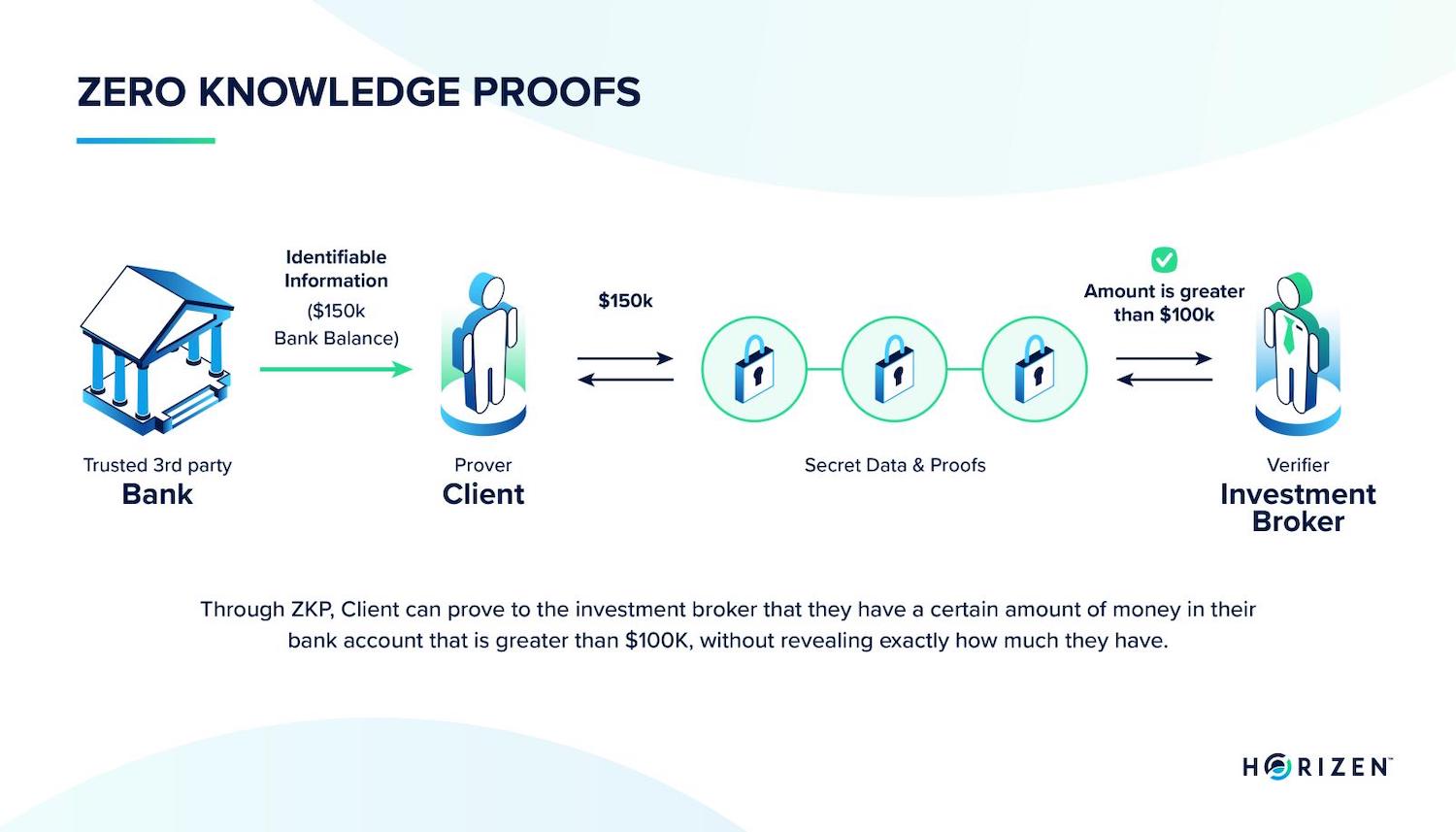
Verification relies on the distinction between the prover, who holds the private data and model, and the verifier, who only needs the public parameters and the proof. As Ethereum.org notes, this allows one party to prove the truth of a statement without sharing its contents or revealing how the truth was discovered. The verifier checks the proof against the public key or smart contract logic. If the math holds, the output is accepted as valid, even though the verifier has never seen the actual weights or the raw input data.
This architecture addresses the dual risks of data leakage and model theft. Sensitive inputs, such as medical records or financial transactions, never leave the prover’s environment. Simultaneously, the proprietary algorithms of the AI provider remain hidden from competitors and auditors. The result is a system where trust is derived from cryptographic certainty rather than transparency, enabling AI inference in untrusted or regulated environments.
High-value applications for zkmL
Zero-knowledge machine learning moves beyond theoretical cryptography into critical infrastructure where data privacy and model integrity are non-negotiable. In 2026, the primary driver for adoption is not convenience, but compliance and competitive protection. The technology enables verification of AI outputs without exposing the underlying proprietary algorithms or sensitive input data.
Healthcare and clinical data
Healthcare providers face strict regulatory environments, such as HIPAA in the United States and GDPR in Europe, which prohibit the unencrypted transmission of patient data to third-party AI models. zkmL allows hospitals to submit patient records to external diagnostic models while keeping the data encrypted. The model processes the encrypted input and returns a verified diagnosis. The hospital receives the result and a cryptographic proof that the computation was performed correctly on the actual data, without ever exposing the raw medical records to the model provider.
Finance and proprietary trading
Financial institutions rely on complex predictive models for trading and risk assessment. These models represent significant intellectual property. If a bank outsources computation to a cloud provider, the provider could theoretically analyze the model architecture to replicate its strategies. With zkmL, banks can verify that the cloud provider executed the correct trading algorithm without revealing the model weights. This ensures that proprietary strategies remain confidential while still leveraging external computational power for high-frequency tasks.
Proprietary model hosting
For AI companies, the model itself is the product. Traditional cloud inference requires uploading the model to the provider's infrastructure, creating a risk of theft or unauthorized replication. zkmL enables "blind inference," where a client can request predictions from a hosted model. The host performs the computation and generates a zero-knowledge proof attesting to the correctness of the output. The client verifies the proof and receives the result, ensuring the host cannot inspect the client's queries or steal the model's internal logic.
Verification comparison
The shift from traditional AI verification to zkmL changes the trust model entirely. Traditional methods rely on trusting the provider's infrastructure and software integrity. zkmL replaces trust with mathematical proof.
| Feature | Traditional AI | zkmL Verification |
|---|---|---|
| Data Privacy | Data exposed to provider | Data remains encrypted |
| Model Integrity | Trusted provider | Cryptographically proven |
| Intellectual Property | Vulnerable to theft | Protected by blind inference |
The Cost of Verification
Zero-Knowledge Machine Learning (ZKML) is no longer just a theoretical exercise in cryptography. It has moved into a phase where the economic viability of generating proofs is the primary bottleneck for adoption. The cost of running these proofs is not a fixed overhead but a variable expense that scales with the complexity of the neural network and the chosen proof system. For financial institutions and high-stakes data providers, this cost structure determines whether ZKML is a viable tool or an expensive novelty.
The computational intensity of generating a zero-knowledge proof requires significant processing power, often necessitating specialized hardware or cloud instances with high CPU and memory allocations. Kudelski Security notes that the overhead of translating machine learning models into arithmetic circuits can be substantial, requiring careful optimization to remain cost-effective. This means that while the data remains private, the act of verifying the model's integrity carries a tangible price tag that enterprises must factor into their operational budgets.
Market infrastructure is beginning to reflect these costs. We are seeing the emergence of specialized ZK-enabled AI services that bundle the computational heavy lifting with verification guarantees. These services act as intermediaries, absorbing the initial proof generation costs in exchange for a subscription or per-query fee. This model lowers the barrier to entry for smaller entities but introduces a dependency on third-party infrastructure. The market is currently fragmented, with costs varying widely based on the underlying technology stack and the scale of the model being verified.
To understand the broader market context, it is useful to look at the crypto assets associated with zero-knowledge infrastructure. The valuation of these tokens often reflects investor sentiment regarding the scalability and adoption rate of ZKML technologies. Monitoring these market indicators can provide insight into the long-term economic trajectory of the sector.
Frequently asked questions about zkmL
What is zero-knowledge proof in AI?
Zero-Knowledge Proof (ZKP) is a cryptographic protocol that allows a prover to demonstrate to a verifier that a statement is true without revealing the underlying data or the method used to derive the conclusion. In the context of AI, this enables organizations to verify that a model was trained on specific datasets or produces correct outputs without exposing proprietary algorithms or sensitive user information.
How does ZKP verify model integrity?
ZKP verifies model integrity by generating a cryptographic proof that the inference or training process adhered to a predefined circuit or logic. The verifier can check this proof against the public parameters of the system to confirm that the output is valid without needing to re-run the computationally expensive model. This ensures that the AI system has not been tampered with and that the results are mathematically sound.
Is ZKP related to meme coins?
Zero-Knowledge Proof (ZKP) is a fundamental cryptographic technology, not a speculative asset or meme coin. While some projects may use "ZKP" in their token names, the technology itself refers to the rigorous mathematical framework for privacy-preserving verification. It is built on established cryptographic principles and is widely adopted by serious blockchain and AI infrastructure projects for its security and efficiency.
What is a practical example of ZKP?
A classic conceptual example involves a cave with a single entrance that splits into two paths, A and B, connected by a locked door. Alice wants to prove to Bob that she knows the passphrase to open the door without revealing the passphrase itself. Bob stands outside and asks Alice to exit through path A or B. If Alice knows the code, she can always comply with Bob's random request. Repeated successful attempts convince Bob of her knowledge without him ever learning the secret.
No comments yet. Be the first to share your thoughts!