How ZK Model Proofs Constrain AI Behavior
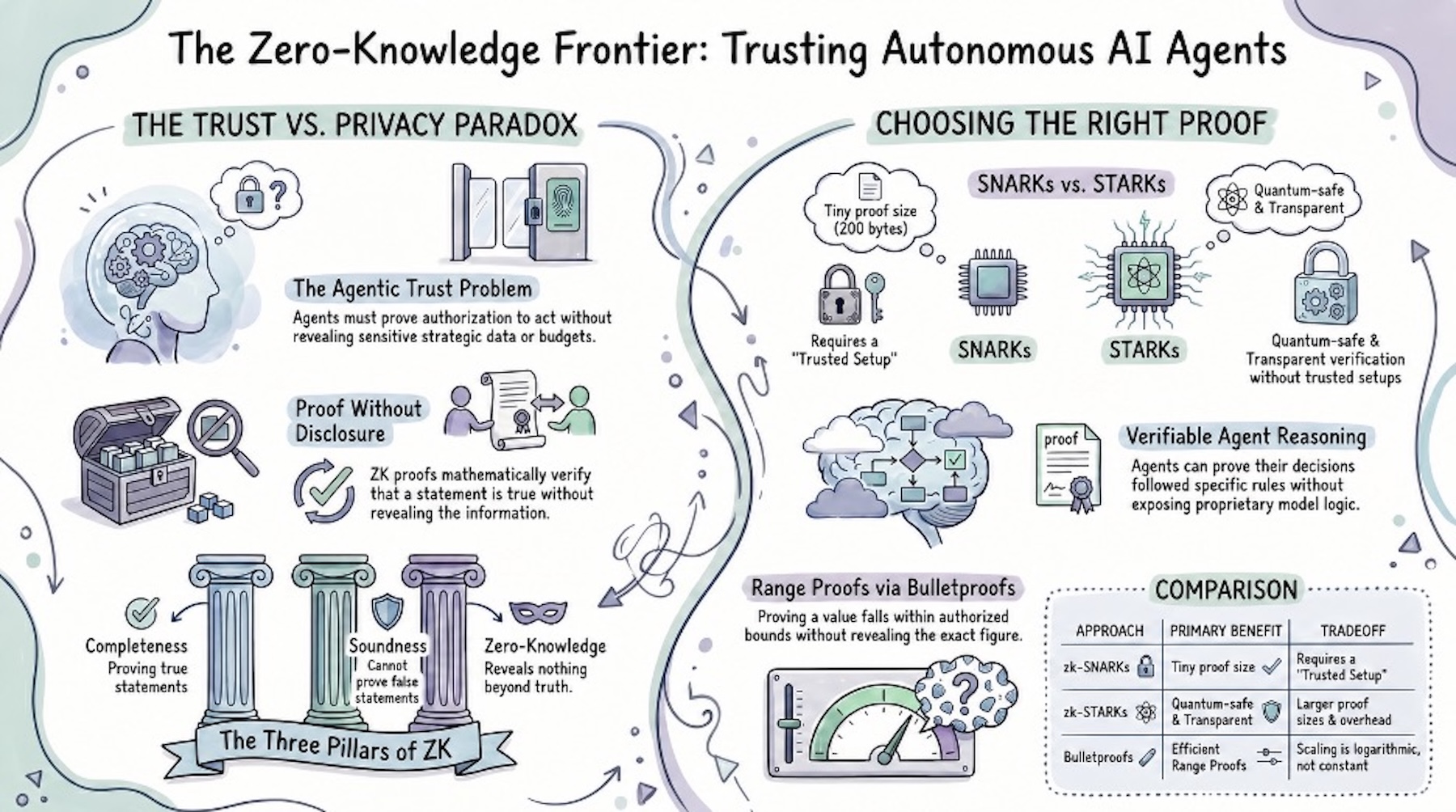
Zero-knowledge proofs (ZKPs) are cryptographic protocols that allow one party to prove a statement is true without revealing the underlying data. In the context of AI governance, this technology shifts the burden of proof from opaque model weights to verifiable mathematical constraints.
The core mechanism involves a prover (the AI model owner) and a verifier (a regulator or auditor). The prover generates a proof that the model executed correctly without exposing its proprietary parameters or training data. This ensures compliance with safety guidelines while preserving intellectual property.
Think of it as a tamper-proof stamp on an opaque envelope. The blockchain or auditor can confirm that the contents—such as a $1,000 transaction or a specific model output—were handled correctly, without seeing the actual money or the model's internal logic. This distinction is vital for high-stakes sectors like finance and healthcare, where data privacy is non-negotiable.
For AI governance, ZK proofs constrain models by enforcing strict behavioral boundaries. If a model deviates from its approved parameters, the proof fails, and the output is rejected. This creates a digital fence that AI systems cannot cross without detection, turning abstract governance policies into immutable code.
Zk model proofs choices that change the plan
Adopting zero-knowledge model proofs requires balancing computational overhead against verifiable trust. Unlike traditional API checks that expose model weights or intermediate outputs, ZK proofs generate a cryptographic receipt that confirms correctness without revealing the underlying data. This shift moves governance from "trust the provider" to "verify the math."
The cost of this verification is not free. Generating a proof for a large language model (LLM) involves complex arithmetic circuits that can take minutes or hours to compute, depending on the proof system and hardware. Verifiers, however, typically check these proofs in milliseconds. The tradeoff is front-loaded: you pay significant compute time to generate the proof, but you gain instant, low-cost assurance for the consumer.
Readers should evaluate three concrete factors when selecting a ZK implementation:
- Proving Time vs. Throughput: Can your infrastructure handle the latency of proof generation? If you need real-time inference, you may need to batch requests or use lighter proof systems.
- Verifier Cost: While cheap, verifier costs scale with proof size. Ensure the proof system you choose keeps the on-chain or on-device verification footprint manageable.
- Trust Assumptions: Some systems require a trusted setup (initial ceremony), while others are trustless. For high-stakes governance, trustless systems are preferred despite higher initial complexity.
| Factor | ZK Model Proofs | Traditional API | Open Weights |
|---|---|---|---|
| Data Exposure | None (only validity) | Full output + inputs | Full model access |
| Verification Speed | Milliseconds | Instant | Slow (inference) |
| Proving Cost | High (CPU/GPU) | Low | Low |
| Tamper Resistance | Cryptographic | Application-level | None |
The market for AI governance infrastructure is evolving rapidly. As computational costs for ZK generation decrease, the barrier to entry for verifiable AI will drop. Investors and developers should watch for breakthroughs in circuit optimization that reduce proving time without sacrificing security.
While the above chart shows general market sentiment, the specific token or asset tied to ZK infrastructure projects often correlates with broader AI adoption trends. Monitor volume spikes as indicators of institutional interest in verifiable AI protocols.
Choose the next step: Turn the research into a practical decision framework
Zero-knowledge proofs (ZKPs) are cryptographic protocols that allow one party to prove a statement is true without revealing any information beyond the validity of the statement itself. In AI governance, this means verifying that a model’s output adheres to safety constraints or regulatory standards without exposing the underlying proprietary data or the model’s internal weights. This capability addresses the core tension in AI deployment: the need for transparency versus the necessity of privacy.
The primary keyword cluster for this decision is ZK model proofs. These proofs are becoming the standard for 2026 AI governance because they offer a verifiable, mathematically sound way to audit AI systems. Unlike traditional black-box audits, ZKPs provide a binary, cryptographically secure guarantee of compliance. This section outlines the practical steps to implement ZK model proofs in your governance framework, moving from theoretical understanding to actionable deployment.
1. Define the compliance boundary
Before implementing ZK proofs, you must clearly define what needs to be proven. In AI governance, this typically involves verifying that the model’s inputs and outputs comply with specific regulations (e.g., GDPR, HIPAA) or internal safety policies. The goal is to create a "compliance boundary"—a set of rules that the model must adhere to, which can then be encoded into a zero-knowledge circuit. This boundary should be specific and measurable, such as ensuring no personally identifiable information (PII) is present in the output or that the model’s decision falls within an acceptable risk threshold.
2. Select the ZK proof system
Not all zero-knowledge proof systems are created equal. For AI governance, you need a system that balances proof generation speed with verification efficiency. zk-SNARKs (Succinct Non-Interactive Arguments of Knowledge) are often preferred for their small proof sizes and fast verification, making them ideal for on-chain or real-time compliance checks. However, they require a trusted setup, which can be a security concern. zk-STARKs (Scalable Transparent Arguments of Knowledge) do not require a trusted setup and are quantum-resistant, but they produce larger proofs. Choose the system that best aligns with your governance requirements and infrastructure capabilities.
3. Encode the model into a circuit
The next step is to translate the AI model’s logic into a format that can be proven using zero-knowledge proofs. This involves creating a "circuit"—a mathematical representation of the model’s computations. Since AI models are typically composed of complex neural networks, this process requires specialized tools and libraries, such as Circom or Halo2, which allow you to define the arithmetic operations of the model in a way that is compatible with ZK proofs. This encoding process is often the most resource-intensive part of the implementation, so it’s crucial to optimize the circuit for efficiency.
4. Generate and verify the proof
Once the circuit is defined, you can generate a ZK proof that demonstrates the model’s compliance with the defined boundary. This proof is generated by the model provider (the prover) and can be verified by any party (the verifier) without revealing the model’s internal data. The verification process is fast and does not require access to the model’s weights or training data. This step is critical for establishing trust, as it allows regulators, auditors, and users to confirm that the model is operating within the agreed-upon constraints without compromising proprietary information.
5. Integrate into the governance workflow
Finally, integrate the ZK proof verification into your existing AI governance workflow. This may involve setting up a verification layer in your API, integrating with a blockchain for immutable audit trails, or creating a dashboard for real-time compliance monitoring. The goal is to make ZK proof verification a seamless part of the model’s lifecycle, from development to deployment. By embedding these proofs into your governance framework, you can ensure that your AI systems remain compliant, transparent, and trustworthy in an increasingly regulated environment.
Spotting Weak ZK Claims in AI Governance
Zero-knowledge proofs are the backbone of verifiable AI, but the market is flooded with half-baked implementations. Before trusting a model’s privacy guarantees, you need to separate rigorous cryptographic standards from marketing fluff. Most vendors fail on three specific fronts: incomplete verification, hidden data leaks, and performance trade-offs that break real-time governance.
Incomplete Proof Systems
Many platforms claim "ZK privacy" but only implement partial zero-knowledge proofs. This means they hide the model weights but leave the input data or inference logs exposed. A true zero-knowledge system must prove the computation was correct without revealing any underlying data. If a vendor cannot show a full SNARK or STARK circuit for the entire inference pipeline, the privacy guarantee is illusory. Look for audits that cover the full stack, not just the model weights.
Side-Channel Data Leaks
Even with perfect ZK circuits, implementation errors can leak information through timing or memory usage patterns. This is known as a side-channel attack. In AI governance, this might mean inferring a user’s private data based on how long a proof takes to generate. Reputable implementations use constant-time algorithms and rigorous constant-memory constraints. If a system’s performance varies wildly based on input size, it is likely vulnerable to these subtle leaks.
Unscalable Proving Times
Some ZK AI models produce valid proofs but take hours to generate them. This makes real-time governance impossible. Effective ZK proofs for AI must balance security with computational efficiency. Look for systems that leverage optimized proving systems like Plonk or Halo2, which reduce proving time significantly. If a vendor cannot demonstrate proof generation in seconds or minutes, not hours, the solution is not practical for live AI governance.
Ignoring Key Verification
A ZK proof is only as good as its verification speed. Some vendors optimize for fast proving but slow verification, which bottlenecks the entire system. In governance, verifiers need to check proofs quickly to maintain throughput. Ensure the verification time is linear or near-linear relative to the circuit size. Slow verification defeats the purpose of real-time compliance checks.
Zk model proofs: what to check next
These questions address the fundamental mechanics behind why ZK proofs are becoming the standard for verifying AI behavior. By separating the proof of correctness from the data itself, governance frameworks can audit models at scale while preserving intellectual property.
No comments yet. Be the first to share your thoughts!