
In the high-stakes arena of AI development, where models devour vast datasets to spit out predictions, one question looms large: can you trust the training data's origins without prying eyes on proprietary secrets? Selective ZK proofs for AI model training data provenance verification offer a resounding yes. These cryptographic marvels let you confirm data lineage, licensing compliance, and training fidelity, all while keeping sensitive details under wraps. Imagine deploying models with ironclad attestations that regulators and partners demand, boosting trust and slashing compliance headaches. At ZKModelProofs. com, we're witnessing this shift firsthand, and it's time to ride the wave.
Why Selective ZK Proofs Are Revolutionizing ZKML Model Provenance
Traditional audits expose too much; blockchain logs fall short on computation proof. Selective zero-knowledge proofs strike the perfect balance, proving subsets of training data met specific criteria without revealing the full dataset. This isn't theory; recent breakthroughs prove it's deployable today. Developers gain privacy-preserving AI provenance, verifying only what's needed, like licensed content inclusion or bias-mitigated sources.
Take the surging demand in enterprise AI. Companies face lawsuits over scraped data; selective ZKPs provide defensible proof. They're lightweight, scalable, and integrate seamlessly into pipelines, motivating teams to prioritize verifiability from day one.
ZKPROV: Certifying Datasets Without the Drama
ZKPROV, from Namazi et al. , stands out in zero knowledge proofs training data verification. It binds datasets, model parameters, and outputs into succinct proofs, ensuring LLMs trained on authority-certified data relevant to queries. Proof generation and verification clock in under 3.3 seconds for models up to 8 billion parameters. That's practical scalability, not pie-in-the-sky.
This framework empowers users to query model responses with confidence, knowing the data passed muster. No more black-box training; instead, verifiable commitments that hold up under scrutiny. For AI builders, it's a motivational nudge: build transparent, get ahead.
Key Metrics for Selective ZK Frameworks
| Framework | Proof Generation Time | Proof Size | Model Size | Key Features |
|---|---|---|---|---|
| ZKPROV | <3.3s (generation + verification) | N/A | Up to 8B parameters | Verifies LLMs trained on certified datasets, maintains confidentiality |
| Verifiable Fine-Tuning | Succinct proofs | Succinct | N/A | Zero policy violations, auditable dataset commitment, policy enforcement |
| ZK-APEX | ~2 hours | ~400MB | N/A | Zero-shot personalized unlearning, Halo2 proofs, minimal memory use |
Picture integrating ZKPROV into your workflow. Upload dataset hashes, train, generate proof, attest. Partners verify instantly, fostering collaborations that were once trust-barriers.
AI Dataset Verification ZK Through Verifiable Fine-Tuning
Akgul et al. 's protocol takes it further, producing succinct ZK proofs that a model was fine-tuned from a public base using a committed dataset and declared program. It enforces quotas flawlessly, preserving utility in parameter-efficient setups. This means real-world pipelines can now self-audit without performance hits.
Opinion: We've waited too long for tools this robust. Selective proofs demystify fine-tuning, letting teams experiment boldly while proving integrity. Enterprises, take note; this levels the playing field against data hoarders.
ZK-APEX complements with zero-shot unlearning, verifying transformations on personalized models via Halo2 proofs in two hours flat, using minimal memory. Proof sizes hover at 400 megabytes, feasible for most setups. Together, these advancements cement selective ZKPs as the backbone of trustworthy AI.
These tools aren't just academic exercises; they're battle-tested for the trenches of AI deployment. Providers can now attest to unlearning without retraining marathons, slashing costs and timelines. In a world where data breaches and IP theft make headlines, selective ZK proofs deliver the accountability enterprises crave, all without handing over the keys to the kingdom.
Overcoming Hurdles in Privacy-Preserving AI Provenance
Sure, proof sizes like ZK-APEX's 400 megabytes raise eyebrows, but optimizations are closing the gap fast. Halo2 circuits keep memory low, and recursive proofs promise even tighter footprints. Scalability shines in ZKPROV's sub-3.3-second verifications, making it viable for production LLMs. Developers, don't let perfect be the enemy of deployable; start small, scale with confidence.
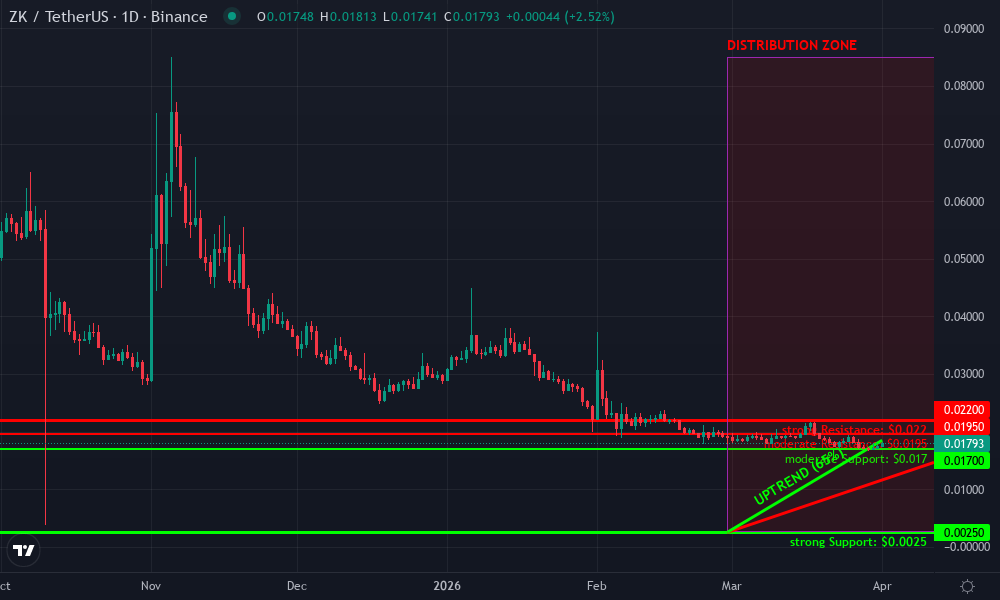
zkSync Technical Analysis Chart
Analysis by Market Analyst | Symbol: BINANCE:ZKUSDT | Interval: 1D | Drawings: 7
Technical Analysis Summary
Draw a prominent downtrend line connecting the peak in early December 2025 around 0.085 to the low in late February 2026 at 0.0025, extending to current price action. Add a short-term uptrend line from the February low to the recent high near 0.0185 in early April 2026. Mark horizontal support at 0.0170 (recent lows) and resistance at 0.0195 (prior consolidation). Use fib retracement from Feb low to March high for potential pullback levels. Highlight volume spike on the bounce with callout. Place entry zone long above 0.0175 with stop below 0.0165 and target 0.0200. Use arrows for MACD bullish crossover suggestion.
Risk Assessment: medium
Analysis: Volatile crypto with downtrend intact but positive ZKML catalysts and volume bounce; medium tolerance suits scaled entries
Market Analyst's Recommendation: Consider long positions on confirmation above 0.0175 with tight stops, target 0.020; monitor ZKML news for bullish bias
Key Support & Resistance Levels
📈 Support Levels:
- $0.017 - Recent daily low cluster and psychological support near current price moderate
- $0.015 - Prior swing low from mid-March consolidation weak
- $0.003 - Absolute bottom from late Feb, major support if retested strong
📉 Resistance Levels:
- $0.02 - Near-term resistance from early April highs moderate
- $0.022 - Previous consolidation zone from late March strong
Trading Zones (medium risk tolerance)
🎯 Entry Zones:
- $0.018 - Bounce above recent low with volume confirmation, aligning with short-term uptrend medium risk
- $0.019 - Break above minor resistance on pullback retracement low risk
🚪 Exit Zones:
- $0.02 - Initial profit target at next resistance 💰 profit target
- $0.019 - Trailing stop or resistance test 💰 profit target
- $0.017 - Below recent low and uptrend support 🛡️ stop loss
Technical Indicators Analysis
📊 Volume Analysis:
Pattern: Increasing on recent green candles suggesting accumulation
Volume spike on the 2.52% up day indicates potential reversal interest amid downtrend
📈 MACD Analysis:
Signal: Bullish crossover forming
MACD line approaching signal from below on daily, supporting short-term bounce
Applied TradingView Drawing Utilities
This chart analysis utilizes the following professional drawing tools:
Disclaimer: This technical analysis by Market Analyst is for educational purposes only and should not be considered as financial advice. Trading involves risk, and you should always do your own research before making investment decisions. Past performance does not guarantee future results. The analysis reflects the author's personal methodology and risk tolerance (medium).
Critics point to compute intensity, yet runtimes for logistic regression proofs on 262,144-sample datasets already benchmark favorably. Pair this with Mina's zkML library or open-source zkml frameworks, and you're off-chain verifying inferences with private inputs. It's not flawless, but the momentum is undeniable, pushing ZKML model provenance into mainstream pipelines.
Integrating selective ZKPs means rethinking workflows from the ground up. Hash your datasets, commit to training programs, generate attestations post-fine-tune. Tools like ZKPROV bind everything cohesively, letting verifiers check relevance without peeking. This shifts AI from opaque oracles to auditable engines, motivating teams to innovate fearlessly.
Enterprise Wins: From Compliance to Competitive Edge
Regulators demand data lineage; selective proofs supply it succinctly. No more endless audits or legal quagmires over unlicensed scrapes. Enterprises verify licensed inclusions, bias controls, even unlearning for GDPR right-to-forget. Akgul's protocol enforces quotas with zero slip-ups, preserving model utility in tight budgets. That's not just compliance; it's a moat against rivals stuck in the dark ages.
Comparison of Selective ZK Frameworks
| Framework | Proof Time | Max Model Size | Key Feature |
|---|---|---|---|
| ZKPROV | <3.3s | 8B params | Dataset certification |
| Verifiable Fine-Tuning | Succinct | N/A | Policy enforcement |
| ZK-APEX | 2hrs | N/A | Unlearning verification |
Opinion: As a trader spotting momentum, I see the same pattern here. Early adopters of AI dataset verification ZK will dominate, while laggards chase scandals. Platforms like ZKModelProofs. com make it frictionless, generating secure attestations for provenance and licensing. Upload, prove, deploy; trust follows.
Beyond verification, these proofs unlock ecosystems. Blockchain devs layer ZKML for off-chain scaling, as a16z notes, processing heavy ML without bloating chains. Nesa's docs highlight verifying computations sans data leaks, fueling trustless marketplaces. Imagine models trading hands with baked-in proofs, royalties auto-enforced via smart contracts.
Challenges remain, like standardizing circuits across frameworks, but open-sourcing efforts like zkml accelerate convergence. Kudelski Security's ZKML verifies model generation faithfully; Provable unlocks auditable ML sans secrets. The dawn of verifiable AI isn't hype; it's here, demanding action.
Forward-thinking builders, equip your models with selective ZK proofs today. Verify zero knowledge proofs training data origins, fine-tune with proof, unlearn securely. At ZKModelProofs. com, we empower this revolution, turning privacy into power. Catch the verifiable wave; your competitors already are.



No comments yet. Be the first to share your thoughts!