ZK-rollups 2026: The enterprise standard
By 2026, zero-knowledge (ZK) rollups have shifted from experimental Layer 2 scaling solutions to the dominant infrastructure for enterprise-grade blockchain applications. Unlike optimistic rollups, which rely on a fraud-proof window to challenge invalid transactions, ZK-rollups generate cryptographic validity proofs that are verified on-chain before settlement. This architectural difference eliminates the finality delay, offering immediate transaction confirmation that is critical for high-frequency trading and regulated financial workflows.
The primary advantage for enterprise adoption is the combination of speed and privacy. ZK-rollups batch thousands of transactions off-chain and submit a single proof to the Ethereum mainnet, drastically reducing gas costs while maintaining the security guarantees of the base layer. For institutions, this means compliance-friendly data handling; zero-knowledge proofs can verify transaction integrity without exposing sensitive customer data or proprietary trading strategies on the public ledger.
While optimistic rollups remain cost-effective for consumer-facing applications where a one-week withdrawal window is acceptable, they struggle with the latency requirements of traditional finance. ZK-rollups solve this by providing instant finality. As Ethereum continues to mature, the industry standard is consolidating around ZK technology for use cases where data confidentiality and settlement speed are non-negotiable.
How ZK-rollups 2026 handle privacy
Enterprise compliance in 2026 hinges on the ability to prove data integrity without exposing the underlying information. Zero-knowledge rollups achieve this by batching thousands of transactions off-chain and submitting a single cryptographic proof to the Ethereum mainnet. This mechanism allows institutions to verify that every transaction adheres to strict regulatory rules—such as anti-money laundering (AML) checks—while keeping sensitive customer data and trade secrets hidden from public view.
The industry relies on two primary cryptographic frameworks: zk-SNARKs and zk-STARKs. zk-SNARKs (Succinct Non-Interactive Arguments of Knowledge) generate smaller proofs that verify quickly, making them ideal for high-frequency trading and low-latency applications. However, they require a "trusted setup," a one-time initialization ceremony that introduces a small, theoretical risk if the secret keys are compromised. In contrast, zk-STARKs (Scalable Transparent Arguments of Knowledge) eliminate the trusted setup entirely, relying on publicly verifiable randomness. While STARK proofs are larger and computationally heavier, their quantum-resistance and transparency make them increasingly attractive for high-stakes financial infrastructure where long-term security is paramount.
For enterprise model provenance, the distinction matters. When financial institutions use AI to assess creditworthiness or detect fraud, regulators require an immutable audit trail. ZK-rollups allow banks to prove that their AI models processed data correctly and adhered to privacy laws without revealing the proprietary algorithms or the personal data of the applicants. This capability transforms privacy from a compliance burden into a verifiable asset, enabling institutions to share insights across the market while maintaining strict data sovereignty.
| Feature | zk-SNARKs | zk-STARKs |
|---|---|---|
| Proof Size | Small | Large |
| Trusted Setup | Required | None |
| Quantum Resistance | No | Yes |
| Verification Speed | Fast | Slower |
Top ZK-rollup architectures for 2026
Selecting a ZK-rollup for enterprise deployment requires aligning cryptographic proof systems with specific throughput and compatibility needs. The current market is dominated by three primary architectures, each solving the scalability trilemma through different technical trade-offs. Understanding these distinctions is critical for minimizing integration risk and ensuring long-term operational viability.
The leading contenders—zkSync, StarkNet, and Polygon zkEVM—represent distinct engineering philosophies. zkSync prioritizes EVM equivalence to reduce developer friction, StarkNet leverages STARKs for massive throughput, and Polygon zkEVM offers a near-identical environment for existing Ethereum developers. The choice between them dictates your stack’s complexity, cost structure, and security assumptions.
| Project | Proof Type | EVM Compatibility | Throughput | Best Use Case |
|---|---|---|---|---|
| zkSync Era | zk-SNARKs | High (EVM Equivalent) | ~10,000 TPS | DeFi & Consumer Apps |
| StarkNet | STARKs | Low (Cairo VM) | ~130,000 TPS | High-Frequency Trading & Gaming |
| Polygon zkEVM | zk-SNARKs | High (EVM Equivalent) | ~10,000 TPS | Enterprise Migration & Institutional DeFi |
The underlying proof mechanism significantly impacts security and finality. zkSync and Polygon zkEVM utilize zk-SNARKs, which offer compact proof sizes and faster verification times but require a trusted setup phase. This introduces a small, albeit managed, trust assumption. StarkNet, conversely, uses STARKs (Scalable Transparent Arguments of Knowledge). STARKs are quantum-resistant and do not require a trusted setup, offering stronger long-term security guarantees at the cost of larger proof sizes and higher computational overhead during generation.
EVM compatibility remains the primary driver for enterprise adoption. zkSync Era and Polygon zkEVM are designed to be EVM-equivalent, allowing developers to deploy existing Solidity smart contracts with minimal modification. This drastically reduces the learning curve and migration costs for institutions already embedded in the Ethereum ecosystem. StarkNet’s Cairo VM offers superior performance for complex computations but requires rewriting smart contracts in the Cairo language, creating a higher barrier to entry for traditional Web2 or Web3 enterprises.
Throughput metrics, while often cited in marketing materials, should be evaluated alongside actual network congestion and transaction costs. StarkNet’s theoretical throughput is significantly higher than zkSync and Polygon zkEVM, making it ideal for applications requiring high-frequency state updates, such as gaming or decentralized order books. However, for standard financial transactions, the throughput of zk-SNARK-based rollups is sufficient to handle enterprise-scale volume without compromising on the security benefits of ZK proofs.
For enterprises, the decision often boils down to developer availability and risk tolerance. If the priority is rapid deployment of existing financial applications, zkSync Era or Polygon zkEVM provide the most direct path. If the application demands maximum scalability and quantum-resistant security, and the team has the resources to adopt Cairo, StarkNet is the superior technical choice. Each architecture offers a viable path to scaling, but the integration effort varies substantially.
Choosing a ZK-stack for business use
Selecting a ZK-rollup infrastructure requires mapping specific enterprise compliance and performance requirements against available cryptographic guarantees. Unlike general-purpose scaling, enterprise privacy stacks demand rigorous verification of security models, developer tooling maturity, and operational cost structures. The decision framework below outlines the essential evaluation steps for deploying zero-knowledge proofs in production.
Verify the underlying cryptographic assumptions and dispute resolution mechanisms. ZK-rollups offer immediate finality upon proof verification, whereas optimistic rollups rely on fraud proofs and challenge windows. For high-stakes financial applications, immediate finality reduces counterparty risk and settlement latency. Ensure the chosen stack provides formal verification of its circuit logic to prevent implementation vulnerabilities.
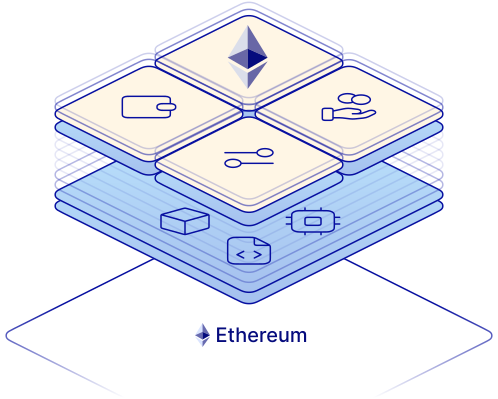
Assess the maturity of the SDK, documentation, and compiler support. Enterprise teams require robust TypeScript libraries, debugging tools, and compatibility with existing smart contract frameworks. A steep learning curve in circuit design can delay deployment by months. Prioritize stacks that offer high-level abstractions and extensive community support to accelerate integration.

Model the costs associated with proof generation, data availability, and transaction fees. ZK-proof generation is computationally intensive and often requires specialized hardware or third-party provers. Compare the per-transaction cost against projected volume to ensure economic viability. Consider the long-term sustainability of prover networks and the potential for economies of scale as adoption grows.
Determine how the rollup integrates with existing liquidity, oracles, and enterprise systems. Seamless cross-chain communication and access to established DeFi protocols are critical for user adoption. Evaluate the availability of bridges, wallets, and analytics tools that support the chosen stack. A fragmented ecosystem can hinder user onboarding and limit the utility of the deployed application.
| Feature | zkSync | StarkNet | Optimistic |
|---|---|---|---|
| Finality | Immediate | Immediate | 7-day challenge |
| Security Model | Validity Proofs | Validity Proofs | Fraud Proofs |
| EVM Compatibility | High | Low (Cairo) | Full |
A structured evaluation prevents costly architectural mistakes. By prioritizing security, tooling, cost, and interoperability, enterprises can select a ZK-stack that aligns with their specific risk tolerance and operational goals.
Enterprise adoption and market shifts
The 2026 blockchain landscape is defined by a pivot from speculative experimentation to institutional utility. ZK-rollups have moved beyond niche applications, becoming the preferred infrastructure for enterprises requiring strict data privacy and regulatory compliance. This shift is driven by clearer regulatory frameworks and the maturation of zero-knowledge technology, which allows organizations to verify transactions without exposing sensitive business logic or user data.
Market sentiment reflects this institutional consolidation. As Ethereum approaches potential new highs, Layer 2 scaling solutions are capturing the majority of transactional volume. The integration of ZK-proofs into Bitcoin and other legacy networks further demonstrates the technology's expanding utility beyond Ethereum's ecosystem. This broad adoption is not merely a trend but a structural change in how financial data is secured and verified.
However, the path to full enterprise integration is not without friction. The recent announcement that ZKsync Lite will sunset in 2026 highlights the high stakes of this transition. While the project proved its concept, the shutdown underscores the necessity of sustainable economic models and robust security audits. Enterprises must carefully evaluate which ZK-rollup providers offer long-term viability, as the market is consolidating around a few key players capable of supporting high-volume, compliant operations.
Frequently asked questions about ZK-rollups
Will Ethereum reach $5,000 in 2026? Ethereum could climb to a new all-time high price above $5,000 in 2026, according to crypto analyst Chris MacDonald. He argues that recent technological upgrades and long-term institutional adoption may be undervalued at current prices. This price action is often tied to the scaling benefits ZK-rollups bring to the mainnet.
What is the trend in blockchain in 2026? In 2026, blockchain and crypto are accelerating into mainstream finance through rising institutional adoption, clearer regulation, and expanding tokenization. Maturing DeFi, growing stablecoin and CBDC use, and major technological advances in interoperability and security define the landscape.
Does Bitcoin use ZKP? For example, in a Bitcoin transaction, ZKP can prove that a user has sufficient funds to complete a transaction without revealing their wallet balance or transaction history. This is achieved through advanced mathematical algorithms that ensure the integrity and confidentiality of the data.
No comments yet. Be the first to share your thoughts!