
In the rush to build ever-larger machine learning models, one nagging issue stands out: how do you prove that your zero knowledge ML models were trained on legitimate, multi-source data without spilling proprietary secrets? Traditional audits demand full disclosure, which kills incentives for data sharing and invites legal headaches. Enter scalable ZK schemes, the cryptographic heavyweights now making scalable ZK data provenance not just feasible, but fast enough for production pipelines.
Untangling Multi-Source ML Data Knots
Picture this: your LLM pulls from licensed datasets, public crawls, and private corpora. Regulators and partners want ironclad proof of compliance, but nobody wants to hand over the keys to the kingdom. Conventional hashes or Merkle trees fall short here; they verify integrity but scream 'data dump required' for multi-source verification. ZK proofs flip the script, letting you attest to training data proofs across disparate origins while keeping contents black-boxed.
Recent work like ZKPROV nails this for transformer-based models. It delivers sublinear scaling on proof generation and verification, slicing through multiple layers without exponential compute bloat. Experiments clock in proofs under 3.3 seconds for 8-billion-parameter behemoths, a game-changer when rivals choke on minutes or hours.
Key Metrics for ZK Data Provenance Schemes
| Scheme | Proof Generation | Verification | Key Features |
|---|---|---|---|
| ZKPROV | <3.3s (up to 8B params) | Sublinear (<3.3s) | Confidential dataset provenance, hides data & model params |
| DeepProve | 1000x faster than existing zkML | 671x faster than existing zkML | Scalable verification of AI inferences for real-world apps |
| Traditional Merkle | N/A | N/A | Full disclosure required, no privacy |
This isn't pie-in-the-sky theory. ZKPROV's framework ties dataset relevance directly to model weights, ensuring your multi-source ML data mix was authorized without peeking under the hood.
DeepProve and the Speed Revolution
While ZKPROV targets training provenance, DeepProve turbocharges inference verification, but its tricks apply broadly to provenance chains. By optimizing circuit designs for non-linear ops via table lookups, it crushes prior zkML benchmarks. Think 1000x faster proofs; that's not incremental, it's a paradigm shift for embedding provenance checks in live deployments.
These tools build on blockchain-proven ZK primitives, like those scaling off-chain compute. a16z crypto highlights how ZK offloads heavy lifting while attesting back on-chain. For ML, this means proving multi-source training happened correctly, from data ingestion to final weights, all verifiable in seconds.
Skeptics might balk at circuit sizes, but optimizations like lookup tables for non-linears (from Cryptology ePrint) shrink them dramatically. Kudelski Security's ZKML take underscores verifying model-data fits without exposure, perfect for decentralized AI where trust is scarce.
Practical Scaling Tactics for ZK Provenance
To deploy these in anger, focus on hybrid circuits: arithmetic for linear layers, lookups for activations. ZKPROV's sublinear verifier scales beautifully across transformer stacks, dodging the quadratic curse of full-model proofs. Pair it with post-quantum tweaks from ScienceDirect frameworks, and you're future-proofed against quantum snoops.
Real-world wins? FC 2022's decentralized AI provenance uses similar ZK for confidential pipelines, scalable to enterprise volumes. Bastian Wetzel's ZKML projects validate private data against public models reciprocally, closing the loop on multi-source ML data flows.
Zcash Technical Analysis Chart
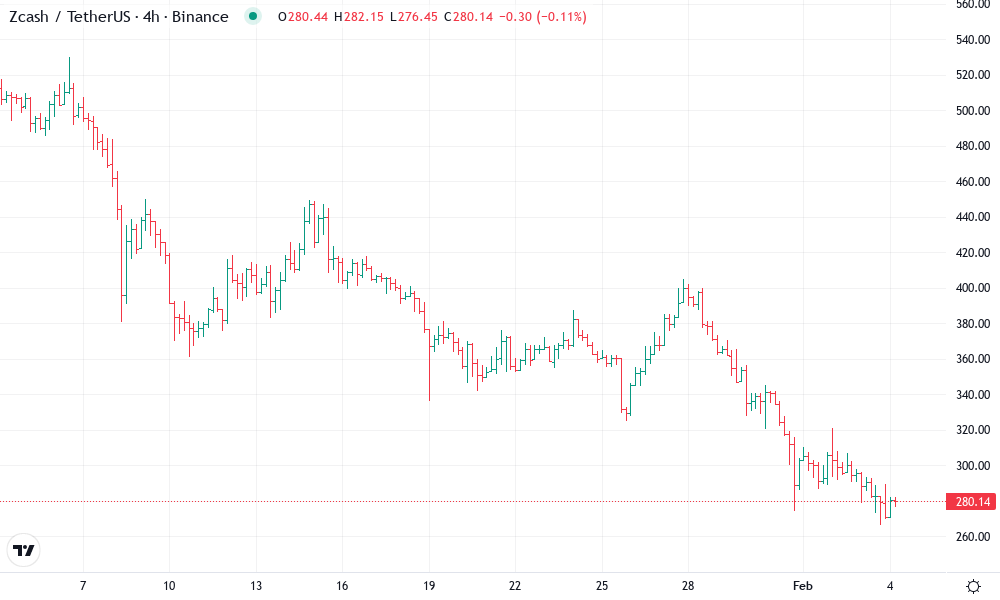
Analysis by Jennifer Voss | Symbol: BINANCE:ZECUSDT | Interval: 1D | Drawings: 6
Technical Analysis Summary
On this ZECUSDT 4H chart spanning late January to early February 2026, draw a primary downtrend line connecting the swing high at 2026-01-22 around 52 USDT to the recent low at 2026-02-04 near 29 USDT, using 'trend_line' tool in red with medium thickness. Add horizontal support at 29-30 USDT marked 'Strong Support - ZK News Bounce?' with 'horizontal_line' in green. Resistance horizontals at 35 USDT (moderate) and 42 USDT (strong), in orange. Use 'rectangle' for consolidation zone Jan 28-Feb 1 between 32-38 USDT. 'arrow_mark_down' at breakdown below 40 on Jan 25. 'callout' on volume spikes for 'Bearish Distribution'. Fib retracement from Jan high to Feb low, 38.2% at ~36 USDT for entry. Text note: 'Compliance fuels alpha - watch ZKML catalysts'.
Risk Assessment: medium
Analysis: Bearish structure but oversold with ZK tailwinds; medium tolerance suits bounce plays
Jennifer Voss's Recommendation: Long support with tight stops, monitor ZKML news for alpha
Key Support & Resistance Levels
📈 Support Levels:
- $29.5 - Recent lows holding with volume spike, potential ZK news support strong
- $35.2 - Prior consolidation base, tested multiple times moderate
📉 Resistance Levels:
- $42 - Key overhead from early drop, strong rejection zone strong
- $37.5 - Recent bounce failure point moderate
Trading Zones (medium risk tolerance)
🎯 Entry Zones:
- $30 - Bounce from strong support amid positive ZKML context, medium risk long medium risk
- $42 - Short entry on resistance retest in downtrend medium risk
🚪 Exit Zones:
- $37.5 - Profit target on minor retrace 💰 profit target
- $28 - Stop below key support 🛡️ stop loss
- $25 - Trailing stop on breakdown 🛡️ stop loss
Technical Indicators Analysis
📊 Volume Analysis:
Pattern: Increasing on downs, divergence on recent low
Bearish volume confirms downtrend but latest spike suggests climax
📈 MACD Analysis:
Signal: Bearish crossover with histogram contraction
Momentum fading, potential bullish divergence emerging
Applied TradingView Drawing Utilities
This chart analysis utilizes the following professional drawing tools:
Disclaimer: This technical analysis by Jennifer Voss is for educational purposes only and should not be considered as financial advice. Trading involves risk, and you should always do your own research before making investment decisions. Past performance does not guarantee future results. The analysis reflects the author's personal methodology and risk tolerance (medium).
Integrating this starts simple: hash datasets into commitments, train with provenance circuits, generate attestations post-hoc. Tools like these slash verification from days to seconds, empowering devs to ship trustworthy models without the provenance paranoia.
No comments yet. Be the first to share your thoughts!