
In the rush to build ever-larger AI models, we've overlooked a quiet crisis brewing beneath the surface: the opacity of training data origins. Imagine deploying a language model in healthcare or finance, only to discover later that its knowledge stems from unverified, potentially biased, or illegally sourced datasets. This isn't mere speculation; it's a vulnerability eroding trust in AI at scale. Enter zero-knowledge proofs, or ZK proofs for AI training data: a cryptographic leap that verifies model provenance zk proofs without exposing a single byte of sensitive information. As someone who's spent decades dissecting sustainable competitive advantages in markets, I see ZK technology as the unbreakable moat AI developers need for long-term viability.

The Imperative for Verifiable AI Datasets in a Distrustful World
AI's power hinges on data, yet provenance remains a black box. Developers scrape web corpora, license proprietary sets, or crowdsource contributions, but end-users can't confirm legitimacy. Regulations like the EU AI Act demand transparency, while enterprises grapple with licensing compliance. Without robust AI dataset verification zk mechanisms, models risk inheriting toxic data, think copyrighted materials unwittingly baked into weights, sparking lawsuits, or privacy breaches masquerading as innovation.
Traditional audits fall short; they require full disclosure, clashing with competitive secrecy. ZK proofs flip this script. A prover demonstrates correct training on committed datasets to a verifier, revealing nothing extraneous. This privacy-preserving data provenance isn't a buzzword; it's verifiable computation at its finest, ensuring models trained faithfully without leaks. From my vantage as a long-term thinker, companies ignoring this will face obsolescence as trust becomes the scarcest resource.
ZKPROV: Redefining LLM Response Trustworthiness
Launched in June 2025, ZKPROV stands out as a game-changer in verifiable AI training datasets. This framework lets users probe an LLM's responses, confirming they're rooted in certified datasets pertinent to their queries, all while shrouding the underlying data. Proof generation scales sublinearly, with end-to-end times under 3.3 seconds for 8-billion-parameter models. That's not incremental; it's a practical breakthrough enabling real-world deployment.
Consider the implications: regulators could attest compliance sans inspection, enterprises prove IP adherence, and users gain confidence in outputs. ZKPROV's elegance lies in its balance, privacy intact, verifiability absolute. In an era where data hoarding fuels arms races, this levels the field, rewarding those who build transparently from the start.
ZKPROV demonstrates that cryptographic rigor can underpin massive-scale AI without sacrificing speed or secrecy.
Yet challenges persist. Neural network complexity demands hefty compute for proofs, historically limiting scope to toy models. Here, innovations bridge the gap.
TeleSparse and zkFL-Health: Scaling ZK to Production Realities
TeleSparse, unveiled in April 2025, tackles ZK-SNARKs' computational bottlenecks head-on. Through sparsification and optimized activations, it slashes prover memory by 67% and generation time by 46%, at a mere 1% accuracy cost. This isn't corner-cutting; it's engineering maturity, making ZK proofs AI training data feasible for deep nets.
Meanwhile, zkFL-Health merges federated learning with ZKPs and TEEs for medical AI. Collaborative training across hospitals verifies updates' correctness without data exposure, crucial for HIPAA compliance and clinical trust. These aren't siloed advances; they form an ecosystem where model provenance zk proofs become standard infrastructure.
Platforms like zkVerify amplify this, offering plug-and-play ZK for private training, inference, and fairness checks. Hardware acceleration ensures scalability, positioning ZK as the backbone for enterprise AI.
Hardware acceleration ensures scalability, positioning ZK as the backbone for enterprise AI. But to truly embed these tools, we must confront lingering hurdles: proof sizes balloon with model depth, verifier costs lag behind, and standardization remains nascent. From a value investor's lens, these are not deterrents but opportunities for pioneers building defensible moats through first-mover protocol adoption.
Overcoming Barriers: Efficiency Gains Pave the Way
Solutions are emerging swiftly. TeleSparse's sparsification trims computational fat without gutting performance, proving that targeted optimizations can democratize ZK proofs AI training data. Pair this with zkFL-Health's hybrid approach, blending ZKPs with TEEs, and you get a blueprint for regulated industries. Medical AI, for instance, demands ironclad proofs that federated updates from disparate clinics adhere to protocols, all sans data spillage. This hybridity signals maturity; pure ZK may suffice for inference, but training's voracious compute calls for pragmatic layering.
zkVerify takes it further, abstracting complexity into APIs for provenance attestation and bias audits. Developers attest model lineage, proving descent from licensed datasets, without unmasking trade secrets. In finance, this verifies stress-test simulations on proprietary histories; in autonomous vehicles, it confirms safety data integrity. The payoff? Auditable AI that withstands scrutiny, fostering ecosystems where trust compounds over time, much like blue-chip dividends.
Comparison of Key ZK Frameworks for Privacy-Preserving AI Training Data Provenance
| Framework | Key Features | Performance Metrics | Primary Use Case | Reference |
|---|---|---|---|---|
| ZKPROV | Cryptographic framework for verifying LLM responses trained on certified datasets without disclosing sensitive data; sublinear scaling for proof generation and verification | End-to-end overhead <3.3s for models up to 8B parameters | LLM response verification and training data provenance | [arXiv:2506.20915](https://arxiv.org/abs/2506.20915) |
| TeleSparse | Sparsification techniques and optimized activation functions for ZK-SNARKs on neural networks | 67% reduction in prover memory usage; 46% faster proof generation; ~1% accuracy trade-off | Privacy-preserving verification of deep neural networks | [arXiv:2504.19274](https://arxiv.org/abs/2504.19274) |
| zkFL-Health | Combines Federated Learning (FL) with ZKPs and Trusted Execution Environments (TEEs) | Provides strong confidentiality, integrity, and auditability (no specific numerical metrics) | Collaborative training for medical AI in healthcare | [arXiv:2512.21048](https://arxiv.org/abs/2512.21048) |
| zkVerify | Integrates ZKPs for verifiable trust; supports various proof systems | Hardware-accelerated proof validation; scalable for AI applications | Private model training, secure inference, model provenance and fairness | [zkverify.io](https://zkverify.io/use-cases/ai) |
Sectoral Shifts: Healthcare and Finance Lead Adoption
Healthcare exemplifies the urgency. zkFL-Health enables hospitals to pool diagnostics data collaboratively, generating ZK proofs of correct aggregation. Regulators verify compliance; clinicians trust outputs. No longer do silos stifle progress; instead, verifiable collaboration accelerates breakthroughs. Finance follows suit, with banks proving risk models trained on cleansed, licensed ledgers. Amid rising data sovereignty laws, privacy-preserving data provenance isn't optional; it's the license to operate.
Yet broader applications beckon. Content platforms could certify recommendation engines against fair-use datasets, muting creator backlash. Supply chains might embed ZK in sensor data provenance, ensuring AI forecasts rest on tamper-proof origins. These use cases underscore a pivotal shift: from data as liability to asset, fortified by cryptography.
Cryptographic verifiability transforms AI from probabilistic black boxes into auditable engines, rewarding patient capital in protocol builders.
Quantifying progress reveals momentum. Proof generation, once hours for modest nets, now ticks seconds for billions of parameters. Verifier latency plummets with recursive SNARKs, enabling on-chain deployment. This trajectory mirrors early internet protocols: clunky at inception, ubiquitous in hindsight.
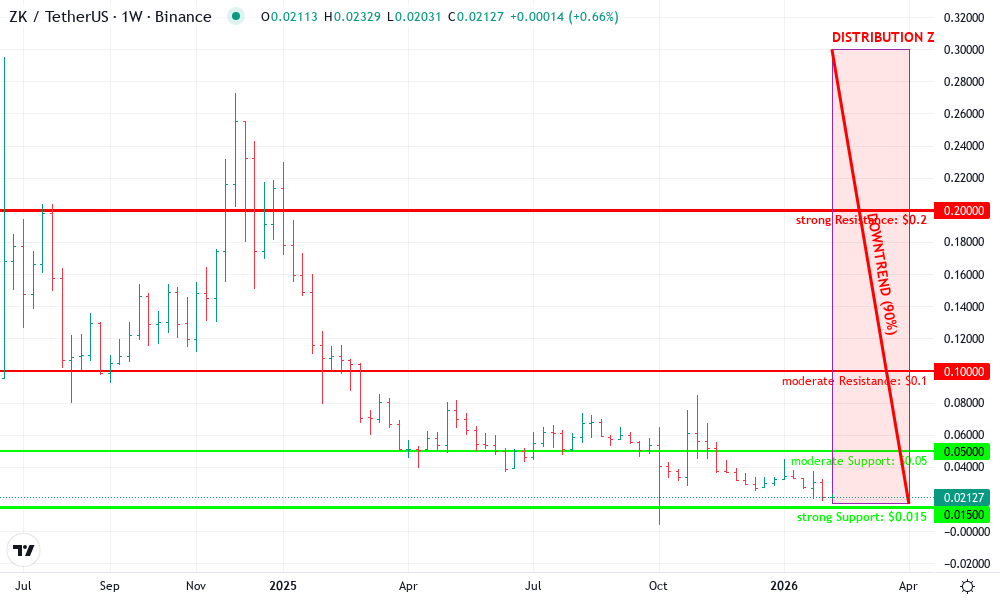
zkSync Technical Analysis Chart
Analysis by David Lee | Symbol: BINANCE:ZKUSDT | Interval: 1W | Drawings: 6
Technical Analysis Summary
As David Lee, a conservative value investor with 20 years focusing on long-term fundamentals, I recommend drawing a prominent downtrend line from the peak at 2026-02-15 (0.300) connecting to recent lows around 2026-04-10 (0.017), using 'trend_line' in red with label 'Speculative Peak to Bottom - Avoid Chasing'. Add horizontal support at 0.015 ('strong_support') and resistance at 0.200 ('prior_peak_resistance'). Mark a distribution range rectangle from 2026-02-15 to 2026-04-10 between 0.017 and 0.300. Use callouts for volume spike on breakdown and MACD bearish signal. No aggressive entries; draw conservative long position only above 0.050 with tight stop below 0.015. Emphasize patience: 'Time in the market, not timing.'
Risk Assessment: high
Analysis: Volatile crypto post-bubble, no clear bottom despite ZK fundamentals; low tolerance demands confirmation
David Lee's Recommendation: Stay sidelined; monitor for long-term base above 0.100 with macro tailwinds
Key Support & Resistance Levels
📈 Support Levels:
- $0.015 - Recent swing low, volume exhaustion strong
- $0.05 - Minor higher low in consolidation moderate
📉 Resistance Levels:
- $0.2 - Major peak from early rally strong
- $0.1 - Mid-distribution retrace level moderate
Trading Zones (low risk tolerance)
🎯 Entry Zones:
- $0.05 - Conservative long above broken support if volume dries up, aligns with ZK news medium risk
🚪 Exit Zones:
- $0.1 - Profit target at prior resistance 💰 profit target
- $0.015 - Tight stop below key support 🛡️ stop loss
Technical Indicators Analysis
📊 Volume Analysis:
Pattern: Spike on downside breakout
Heavy selling volume confirms distribution phase
📈 MACD Analysis:
Signal: Bearish crossover below zero
Momentum shift negative post-peak
Applied TradingView Drawing Utilities
This chart analysis utilizes the following professional drawing tools:
Disclaimer: This technical analysis by David Lee is for educational purposes only and should not be considered as financial advice. Trading involves risk, and you should always do your own research before making investment decisions. Past performance does not guarantee future results. The analysis reflects the author's personal methodology and risk tolerance (low).
Building Moats: The Long-Term Investment Thesis
As a 20-year value hunter, I prioritize enduring edges. ZK-enabled firms crafting verifiable AI training datasets possess them. OpenAI or Anthropic may dominate compute races today, but provenance laggards invite commoditization. Imagine models interchangeable save for attested lineage; the certified win shelf space in boardrooms. Startups like zkVerify, iterating on hardware-proof synergies, echo early cloud providers: infrastructure that outlasts apps.
Risks linger, chiefly quantum threats, but post-quantum ZK variants advance apace. Interoperability standards, perhaps via alliances like a16z-backed initiatives, will consolidate gains. Enterprises should audit stacks now, prioritizing AI dataset verification zk roadmaps. Developers, integrate ZK from inception; retrofits bleed margins.
The arc bends toward transparency. ZK proofs don't just verify; they certify sustainability, aligning incentives across the stack. In a world awash in synthetic data, authentic, provable origins become premium. Those staking claims here compound value patiently, outpacing hype cycles. AI's future isn't larger models; it's trustworthy ones, etched in cryptographic certainty.



No comments yet. Be the first to share your thoughts!